Frei Otto
Born: 1925 | Siegmar, Saxony, Germany
Died: 2015 | Leonberg, Baden-Württemberg, Germany
Awards: RIBA Gold Medal (2006), Prizker Prize (2015)
Projects: Federal Garden Exposition, Montreal Expo 1967 West German Pavilion, 1972 Munich Olympic Arena
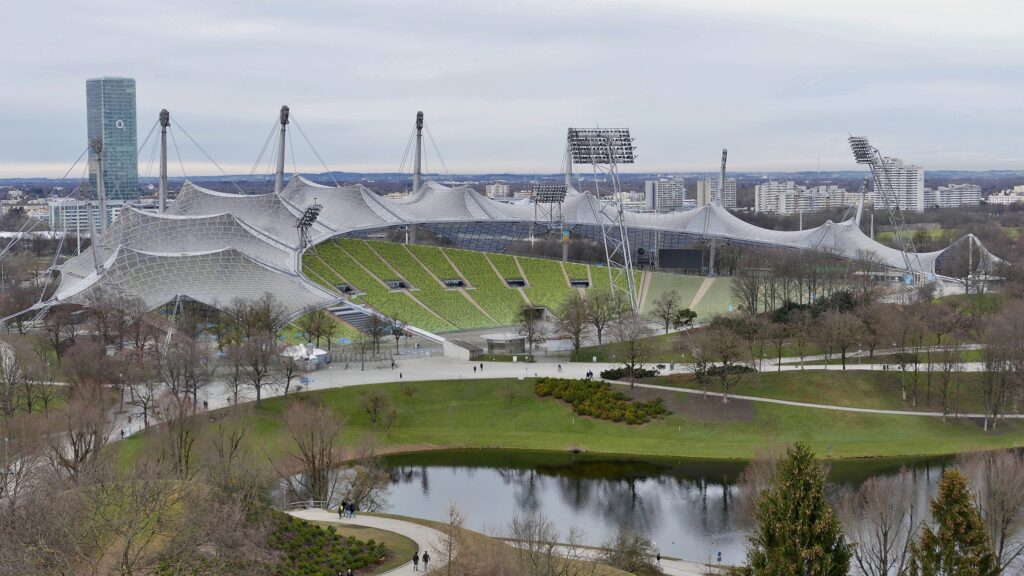
Olympic Stadium (Olympiastadion), Munich, Germany (1968-1972)
Frei Otto, a pioneering figure in modern architecture, was born on May 31, 1925, in Siegmar, Germany, and passed away on March 9, 2015. His work, characterized by innovative, lightweight structures and a deep commitment to sustainable and ecological design, has had a profound impact on contemporary architecture.
Otto’s early life was marked by a fascination with natural forms and structures, which later influenced his architectural style. He studied architecture at the Technical University of Berlin after World War II, during which he was a soldier and prisoner of war. His experiences during the war, particularly witnessing the efficiency and minimalism of tents and other temporary structures, deeply influenced his architectural philosophy.
In 1952, Otto founded his own studio, the Institute for Lightweight Structures, at the University of Stuttgart. Here, he embarked on a journey of architectural exploration, focusing on tensile and membrane structures. His design philosophy revolved around the idea of creating buildings that mimic the efficiency and elegance of natural forms, particularly those that could adapt to their environments with minimal material usage.
Otto is perhaps best known for his work on the German Pavilion at the 1967 Montreal Expo and the Olympic Stadium for the 1972 Munich Olympics. These structures showcased his innovative use of tensile and lightweight structures, earning him global acclaim. The German Pavilion, in particular, was a landmark in the use of tensile structures and remains a seminal work in the field.
Throughout his career, Otto collaborated with numerous architects and engineers, contributing to a variety of projects around the world. His commitment to sustainability was evident in his approach to design, always seeking to minimize environmental impact while maximizing aesthetic and functional qualities.
Otto’s influence extends far beyond his built works. He was a dedicated educator and researcher, deeply invested in the development of architectural theory and practice. His work has inspired generations of architects and continues to be a touchstone for those interested in sustainable, innovative, and ecologically sensitive design.
Frei Otto was posthumously awarded the Pritzker Architecture Prize in 2015, a testament to his enduring legacy and the profound impact he had on the field of modern architecture. His approach to design, blending scientific rigor with artistic vision, remains a guiding force for architects and designers worldwide.